Holiday Airbnb cleaning is less about working faster and more about how the week is set up. Back-to-back bookings leave only a few hours between checkout and check-in, so the Airbnb cleaning tips that hold up in December are the ones that move work out of that window: spare linens, counted supplies, and heavier tasks booked before the season fills.
What Airbnb cleaning tips matter most during the holidays?
Protect the turnover window. Every decision below exists to keep a tight gap between checkout and check-in from becoming a rushed clean.
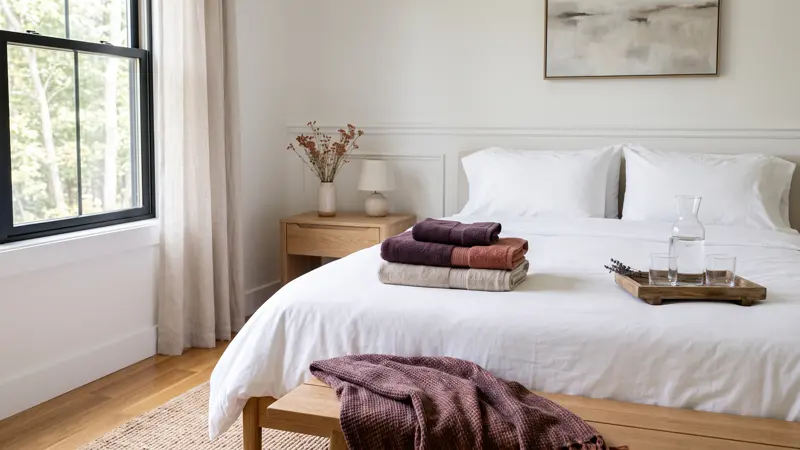
- Keep a spare set of linens and towels for every bed and bath, so beds are made from the closet while the used set washes.
- Give each consumable a par level and count against it. Guessing is what produces a bathroom with no toilet paper on December 26.
- Move heavy tasks out of the season. Appliance interiors, cabinet interiors, blankets and shower curtains belong to the quiet weeks.
- Pre-stage supplies by room, so no one walks back to the closet mid-task.
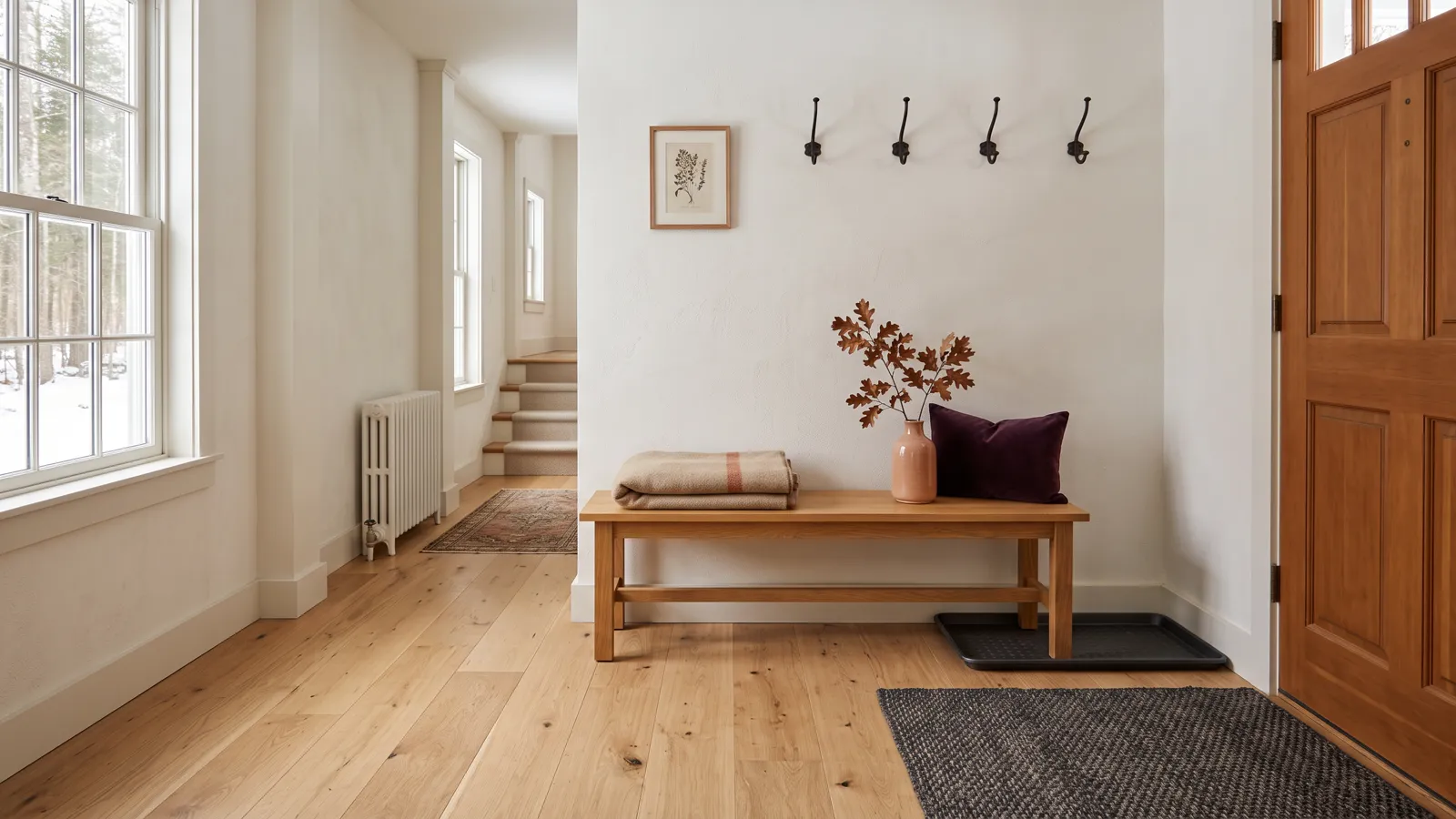
- Plan the entry. In New England, winter grit arrives with every guest.
- Schedule against the real clock. Write the checkout and check-in times into the booking, then set the scope to fit them.
The full turnover cleaning checklist covers the room-by-room version; this article is the holiday calendar wrapped around it.
How do you prepare a rental before the holiday season starts?
Do the slow work in November, while there is still a free day on the calendar. A task that fits easily into a quiet week does not shrink because the calendar is full, and that is where a turnover window breaks.
| Task | Where it fits |
|---|---|
| Inside the refrigerator, inside the oven | Before the season; add-on, quoted by condition |
| Inside cabinets and pantry organization | Before the season, arranged separately |
| Blankets, duvet inserts, mattress pads, shower curtains and liners | Before the season, then as needed |
| Baseboards, vents, light fixtures, interior window glass | Before the season, then on a rotation |
| Spare linens, towels and bin liners stocked to par | Before the season, topped up weekly |
| Linens, towels, bathrooms, kitchen surfaces, floors, restocking | Every turnover |
| Microwave inside and out | Every turnover |
| Entry mat, boot tray, floor at the door | Every turnover, more than once in winter |
Two more things before the first holiday booking. Count the linen inventory against the busiest week on the calendar, not an average week, and agree in writing who buys supplies, who counts them and who reports what is low.
How do you clean for Airbnb between back-to-back bookings?
Work in one pass per room and never re-enter a finished room. On a same-day turnover, the time is lost in walking, backtracking and waiting on laundry, not in the cleaning itself.
- Walk the home once and start the laundry. Strip the beds, note anything damaged or left behind, then get the machine running. Laundry is the only task that works while you work.
- Make the beds from the spare set. The home starts looking ready early, which also tells you how much of the window is left.
- Clear waste and dishes next. Bins, sink, dishwasher. Everything after this is surfaces and floors.
- Clean top to bottom, back to front. Start in the room farthest from the entry and finish at the door, so no one crosses a floor that is already done.
- Restock as you leave each room. Paper, soap, towels, liners. Going back for it later costs two trips.
- Walk through, photograph, lock up. Re-check each room against the list, then send the host the photo record and a message that the home is ready.
The walkthrough is the one step not to compress. A skipped final check is what produces a message from a guest two hours later.
What needs extra attention after guests cook a holiday meal?
The kitchen. A rental that hosted a holiday dinner needs more kitchen time than the same rental in March, and the rest of the visit has to be planned around that.
The FDA's advice for a home kitchen applies here: wash cutting boards, dishes, utensils and counter tops with hot soapy water after each food item, and if you use cloth towels rather than paper, launder them often on the hot cycle. Check the appliance dials too, since guests adjust them. The FDA puts the refrigerator at 40 degrees Fahrenheit or below and the freezer at 0 or below.
Settle the food question in advance. The FDA's rule is to refrigerate or freeze perishables within two hours of cooking or purchasing, and within one hour when it is above 90 degrees outside. Anything perishable sitting out when you arrive has been out longer than that, so it goes in the trash rather than into the refrigerator for the next guest.
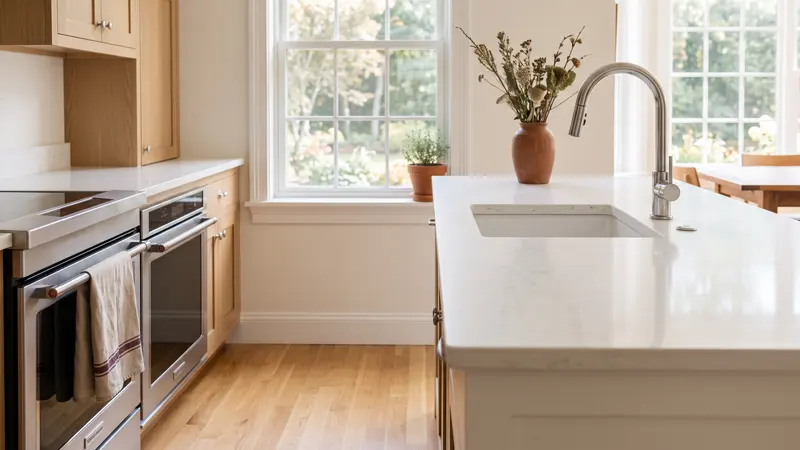
Add time for the range and hood front, the sink and drain, and the floor in front of the stove.
What does winter add to an Airbnb turnover in New England?
Two things: grit at the door and moisture in the fabrics. Both are predictable, which means both can be planned for.
Every arrival tracks salt and grit through the door, so the entry gets cleaned at the start of the visit and again at the end. A washable mat, a tray for wet shoes and a mop at the door do most of that work. In a Salem or Methuen rental the mat is a task of its own: shake it out rather than vacuuming over it.
Moisture is the quieter problem. Wet coats, damp towels and a closed-up home between stays all add humidity. The EPA advises keeping indoor humidity below 60 percent, ideally between 30 and 50, and notes that damp materials dried within 24 to 48 hours usually will not grow mold. In practice: run the dryer to completion, never fold linens still cool to the touch, and run the bathroom fan during and after the clean.
Heating season also changes what is worth checking. The CPSC recommends testing smoke and carbon monoxide alarms monthly and replacing their batteries annually, with CO alarms on each level of the home and outside sleeping areas. A holiday week with a full house is not when you want to find a dead alarm.
A 3 p.m. check-in in December happens after dark, so check mirrors, glass and faucets under a side light during the walkthrough.
How do you keep the air right when the windows stay closed?
Use the fans you already have. The EPA notes that local bathroom or kitchen fans that exhaust outdoors remove contaminants directly from the room and raise the outdoor air ventilation rate, and that opening windows and doors or operating fans increases ventilation when the weather permits.
In January, "when weather permits" means a few minutes, not an afternoon. Run the bath fan for the whole visit, crack a window in the room you are in, and close it before you leave. The EPA also recommends more ventilation during short-term activities that generate pollutants, including cooking and maintenance work.
Scent follows the same logic. A ventilated, cleaned home does not need perfume, and heavy fragrance reads as cover-up to a guest arriving from the cold.
When does disinfecting matter between winter guests?
Clean everything every time, and disinfect the high-touch surfaces when there is a reason. The CDC says cleaning alone removes most harmful viruses or bacteria from surfaces, and recommends cleaning high-touch surfaces such as light switches, doorknobs and countertops regularly and after you have visitors in your home.
A rental has visitors by definition, which is why many hosts keep a short high-touch list for every turnover: switches, handles, remotes, faucet levers, counters. The CDC reserves disinfecting for when someone is sick or at higher risk of getting sick because of a weakened immune system. If a host tells you a guest was ill, that is the turnover where disinfecting earns its place.
If turnover work is new to you, what turnover cleaning is covers the basics.
How Andemora handles holiday turnovers
Andemora's Turnover Cleaning follows the Triple-A Standard on every visit, including the busy weeks. The team arrives on time, uniformed and with its own supplies, and messages on the way. The home is cleaned top to bottom, from the back of the house to the front door, and personal items go back in their exact place.
Every room is then re-checked against the checklist under room light and natural light. At lock-up the lights go off, the doors are locked, and the host gets a message that the home is ready, with a photo report. Towels are folded the same way each time, bins get fresh liners, the scent stays neutral, and keys, codes and routines are never discussed.
Inside the microwave is part of every visit. Inside the refrigerator and inside the oven are add-ons quoted by the condition of the appliance, and inside cabinets and pantry organization are arranged separately, which is why those tasks are better booked before the season than during it.
If you host in Southern New Hampshire or the Merrimack Valley, you can request an estimate for your rental.
Frequently asked questions
Does the Airbnb cleaning fee cover dishes?
What the fee covers is whatever the host and the cleaner agreed in writing, so put it in the scope rather than leaving it to habit. Most turnover scopes include clearing the sink, running or unloading the dishwasher and putting kitchenware back in place.
How many sets of linens should a rental keep for holiday weeks?
At least two full sets per bed and bath, and a third when turnovers run back to back. The spare set is what lets the beds be made while the used set is still in the dryer.
Can one cleaner handle a same-day holiday turnover alone?
In a small one-bedroom, often yes. Once there are several bedrooms, two bathrooms or laundry done on site, a second pair of hands is usually what keeps the visit inside the window.
What if guests leave decorations up?
Decide before December who takes them down and who stores them, because it is not part of a standard turnover. Needles, sap and loose glitter add real time to the floors and the vacuum.
Should the thermostat be left alone between winter guests?
Set it to the level the host specifies for empty days rather than turning it off, and tell the host if you find it changed. A cold house between stays is a plumbing question, not a cleaning one.
Sources
- When and How to Clean and Disinfect Your Home · CDC
- Improving Indoor Air Quality · EPA
- A Brief Guide to Mold, Moisture and Your Home · EPA
- Safe Food Handling · FDA
- CO Alarms · U.S. Consumer Product Safety Commission